
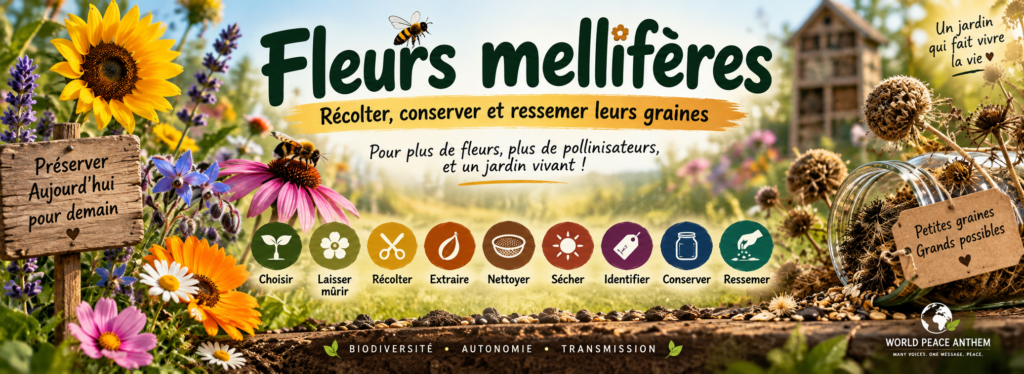
Harvest, store and resow their seeds
Bee-friendly flowers play an important role in a thriving garden.
Bee-friendly flowers can also be chosen for their ability to produce reproducible seeds easily.
They provide food for the bees, bumblebees, butterflies and other pollinators, support biodiversity, and can also produce seeds that are easy to store and resow year after year.
Preserving the seeds of bee-friendly flowers makes it possible to renew pollinator-friendly areas each year.
Depending on the species, they may be annuals, biennials or perennials. The harvesting time and storage method may therefore vary.
By resowing your bee-friendly flowers, you help maintain a floral diversity that benefits the garden.
The aim is to follow a simple cycle:
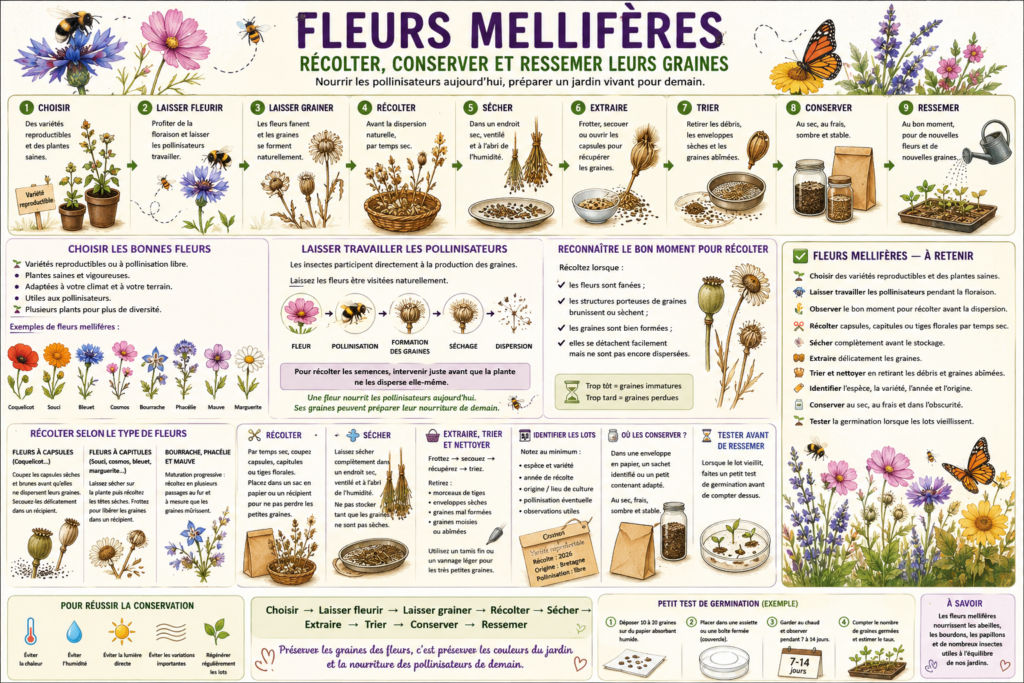
Choose → Let flower → Let seed → Harvest → Dry → Extract → Sort → Store → Resow
🌱 Choose the right flowers
To produce seeds intended for storage, give preference to:
- some reproducible varieties or open-pollinated varieties;
- healthy, vigorous plants;
- flowers that are well adapted to your climate and growing conditions;
- species that are beneficial to pollinators;
- several plants whenever possible, in order to preserve greater diversity.
Among the useful flowers, you can include, for example:
🌺 poppy — 🌼 marigold — 💙 cornflower — 🌸 cosmos — 🌿 borage — 🌻 phacelia — 🌺 mallow — 🌼 daisy.
🐝 Let the pollinators do their work
For many bee-friendly flowers, insects play a direct role in seed production.
When the flowers open, allow them to be visited naturally by pollinators.
Over time:
flower → pollination → seed formation → drying → dispersal.
To harvest the seeds, you simply need to intervene just before the plant disperses them naturally..
A flower feeds pollinators today. Its seeds can help provide their food tomorrow.
🌾 Recognise the right time to harvest
Not all flowers release their seeds in the same way.
Some form seed pods, others form dry flower heads, and some produce tiny seeds that detach very easily once mature.
The right time generally comes when:
- the flowers have faded;
- the seed-bearing structures begin to turn brown or dry out;
- the seed-bearing structures begin to turn brown or dry out;
- they detach easily without having been dispersed yet.
Harvesting too early results in immature seeds. Waiting too long may allow the plant to sow them for you.
🌺 Flowers with seed pods
The poppy forms a capsule filled with many small seeds.
When the capsule becomes dry and brown, cut it before it fully disperses its seeds.
Place it in a container or paper bag, then shake it gently to collect the seeds.
🌼 Flowers with seed heads
The marigold, cosmos, cornflower or daisy produce their seeds in the dried flower heads.
Allow the flower heads to dry on the plant, then harvest them when the seeds are fully formed and detach easily.
Rub them gently over a container to release the seeds.
🌿 Borage, phacelia and mallow
For these species, seed maturation can be more gradual.
It may be useful to harvest the seeds in several stagesas they mature.
Observing the plant often remains the best guide for determining the right time to harvest.
✂️ Harvest the seeds
Preferably harvest in dry weather, when the seeds have reached maturity but before they are completely dispersed.
Depending on the species, you can cut:
- the seed pods;
- the flower heads;
- the flower stalks;
- or collect the ripe seeds directly.
Place them in a paper bag, a container or on a clean cloth so as not to lose the small seeds during handling.
💨 Dry completely
Even if the seeds already appear dry at harvest time, allow them to finish drying in a place that is:
dry, well ventilated and protected from moisture.
Avoid sealing them immediately in an airtight container.
A seed that is still damp can become mouldy before it ever has the chance to be resown.
🧺 Extract, sort and clean
When the flowers or seed pods are completely dry:
rub → shake → collect → sort the seeds.
Remove:
- pieces of stems;
- the dry husks;
- poorly formed seeds;
- seeds showing signs of mould or deterioration.
For very small seeds, a fine sieve or very gentle winnowing can be used.
Harvesting a flower does not end its story: preserving its seeds allows it to begin again.
🏷️ Label the batches
For each batch of seeds, note at least:
🌸 the species and variety
📅 the year of harvest
📍 the origin or growing location
🐝 the pollination conditions, if known
📝 any useful observations
Example:
Cosmos — variété reproductible
Harvest: 2026
Origin: Brittany
Pollination: open
🫙 Where should they be stored?
Once completely dry, place the seeds in a paper envelope, a labelled bag, or a small suitable container.
Store them in a place that is:
dry, cool, dark and stable.
Avoid moisture, heat, direct sunlight and significant temperature fluctuations.
⏳ How long?
When properly dried and stored, many flower seeds can retain their ability to germinate for several years.
However, the length of time varies depending on the species and storage conditions.
It is therefore preferable to renew the batches regularly rather than waiting until they become too old.
🌱 Test before resowing
When a batch begins to age, carry out a small germination test before truly relying on them.
Preserving flower seeds also means preserving a source of food for pollinators in future seasons.
✅ Bee-friendly flowers — Key points
- 🌱 Choose reproducible varieties and healthy plants.
- 🐝 Let the pollinators do their work during flowering.
- 🌾 Observe the right time to harvest before natural dispersal.
- ✂️ Harvest seed pods, flower heads or flower stalks in dry weather.
- 💨 Dry completely before storage.
- 🤲 Extract the seeds gently.
- 🧺 Sort and clean by removing debris and damaged seeds.
- 🏷️ Label the species, variety, year and origin.
- 🫙 Store in a dry, cool and dark place.
- 🌱 Test germination as the batches age.
Choose → Let flower → Let seed → Harvest → Dry → Extract → Sort → Store → Resow
Preserving flower seeds means preserving the colours of the garden and the food of tomorrow’s pollinators.
🇫🇷 Version française
🇬🇧 English version
To understand the full approach, visit the Seed Harvesting Project and discover the other practical guides dedicated to seed preservation and the passing on of knowledge.
Also discover the work of FAO on the conservation of plant genetic resources for food and agriculture.