
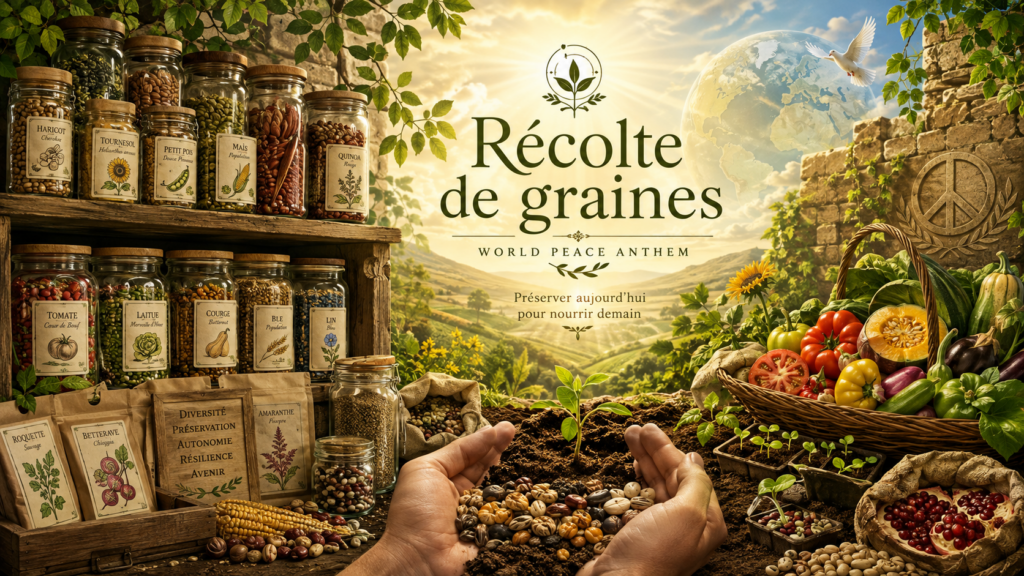
Preserve Today to Feed Tomorrow
Seed Harvesting is a project by World Peace Anthem dedicated to the preservation of reproducible seeds, heritage varieties, and the knowledge needed to grow, harvest, store, and pass them on.
In a world where our food supply increasingly depends on complex systems of production, transport and distribution, regaining the ability to produce some of our own food can become essential.
This project is not based on fear or on the prediction of a catastrophe.
It is based on three simple principles:
Plan. Preserve. Pass It On.
Preserving seeds that can be resown, maintaining heritage and reproducible varieties, learning how to produce your own seeds, and passing on this knowledge means preserving a fundamental possibility:
the ability to continue producing food tomorrow.
🌱 Diversity — preserve different species and varieties.
🌾 Preservation — preserve the seeds and the knowledge that comes with them.
🤲 Autonomy — regain the ability to produce part of our own food.
🌍 Resilience — be better prepared to face difficulties and change.
🕊️ Transmission — preserve this knowledge for future generations.
🌱 Why the Seed Harvesting Project?
For thousands of years, human beings have learned to select, harvest, preserve and pass on their seeds.
This simple knowledge allowed each generation to prepare for the next.
Today, our food supply relies heavily on highly organised production and distribution systems. This organisation brings us many benefits, but it can also distance us from an essential form of knowledge:
knowing how to produce some of our own food.
The project Seed Harvesting was born from this reflection.
It is not about going backwards or rejecting modern agriculture.
It is about preserving, alongside it, something precious:
the ability to produce a new harvest from the seeds we already have.
To achieve this, World Peace Anthem aims to encourage the preservation of reproducible seeds, particularly heritage, local or open-pollinated varieties.
These seeds can be grown, harvested and, when the conditions for reproduction are properly controlled, resow a new generation of plants.
This is the cycle we want to preserve:
🌱 Sow → Grow → Harvest → Preserve → Resow
🌾 Preserving varieties that can continue to thrive
Not all seeds serve the same purpose.
Hybrid varieties F1, for example, can produce excellent plants and excellent vegetables.
However, seeds collected from these plants generally do not faithfully reproduce the characteristics of the previous generation.
To build a reserve intended to be used and renewed year after year, the project therefore focuses mainly on:
🌱 reproducible varieties
🌾 heritage varieties
🌍 local varieties
♻️ open-pollinated seeds
The goal is not simply to fill jars with seeds.
The goal is to preserve seeds that are capable of remaining part of a living cycle.
🕊️ Preserve without giving in to fear
No one can know exactly what difficulties tomorrow may bring.
Climate, economic, energy or geopolitical challenges can, however, remind us just how essential access to food remains.
Preparing a few seeds, learning how to grow them, and knowing how to reproduce them does not mean expecting a catastrophe.
It simply means preserving knowledge and keeping an option open.
Just as we learn first aid skills while hoping never to need them in a serious situation, learning how to produce some of our own food is knowledge that can never be useless.
Planning ahead is not being afraid.
Planning ahead means preserving an option for tomorrow.
🌱 Which seeds should be preserved?
To build a truly useful reserve, the goal is not to accumulate seeds at random.
Priority should be given to reproducible seeds, adapted to your climate and offering real food value.
A good reserve should above all aim for:
🌱 diversity
♻️ the ability to reproduce the plants
🌍 adaptation to the local environment
🥕 food value
📅 different harvest periods
🫘 Legumes
Beans, peas and broad beans are particularly valuable.
They are relatively easy to preserve as dried seeds and also provide an important source of food.
Examples :
- dried beans;
- climbing beans;
- peas;
- broad beans;
- chickpeas, depending on the climate.
🍅 Vegetables with reproducible seeds
Many vegetable varieties can be part of a living seed reserve:
- heritage tomatoes;
- peppers;
- chilli peppers;
- aubergines;
- lettuces;
- radishes;
- beets;
- carrots;
- leeks;
- onions.
For tomatoes, the project particularly recommends the following: heritage or open-pollinated varietiesrather than F1 hybrids when the goal is to save and reuse the seeds year after year.
🎃 Squashes, courgettes and cucumbers: watch out for cross-pollination
These plants require greater care.
Some varieties can easily cross-pollinate when they flower near one another.
The fruit harvested in the first year may appear perfectly normal, but the seeds collected from it can produce a very different plant the following year.
To preserve a variety faithfully, it may therefore be necessary to use a controlled pollination or appropriate isolation.
🌽 Maize: another plant to watch carefully
Maize is pollinated mainly by the wind.
Different varieties grown too close together can therefore cross-pollinate easily.
Preserving a variety therefore requires careful planning and a sufficient number of plants.
🌻 Useful and complementary plants
A seed reserve may also include :
- sunflower;
- amaranth;
- buckwheat;
- quinoa, depending on the climate;
- aromatic plants;
- bee-friendly flowers.
Flowers are particularly important because they help support the presence of pollinators,which are essential to many crops.
🌳 And what about fruit trees ?
Seeds and stones can also be used to grow new trees.
But one essential distinction must be understood:
Growing a tree does not necessarily mean reproducing the same fruit variety.
An apple seed can grow into an apple tree, but not necessarily the same apple variety it came from.
A mango seed can also germinate and grow into a tree without reproducing exactly the same characteristics as the original fruit.
That does not make them any less valuable.
It simply means that we need to distinguish between:
preserving a species,
growing a new plant,
et reproduire fidèlement une variété.
🫙 How to store your seeds properly ?
Collecting seeds is not enough.
For them to remain viable and be sown again later, they must be properly prepared and stored under the right conditions.
For most vegetable seeds intended for dry storage, four factors are particularly important:
💧 avoid moisture
🔥 avoid high temperatures
☀️ avoid direct sunlight
🐛 protect seeds from insects and pests
🌬️Dry thoroughly before storing
A seed stored while it still contains too much moisture may develop mould or quickly lose its ability to germinate.
After harvesting, the seeds should therefore generally be cleaned and then dried thoroughly, in a dry, well-ventilated place away from direct sunlight.
The time required depends on the species and the size of the seeds.
🫙 Choose a suitable container
Once completely dry, the seeds can be placed in:
- paper envelopes;
- properly labelled bags;
- small suitable containers;
- then, if necessary, in a jar or box that protects the contents from moisture and pests.
The goal is to create an environment that is stable, dry, dark and cool.
🌡️ Avoid significant temperature fluctuations
Ideally, a seed reserve should not be kept in a place exposed to significant fluctuations in temperature or humidity.
A dry, relatively cool room, a cupboard protected from light, or a space specifically dedicated to seed storage may be suitable.
⚠️ Not all seeds are stored in the same way
This is a fundamental principle of the project Seed Harvesting.
Bean, tomato and many other vegetable seeds can be stored dry.
Other seeds, particularly those of certain tropical species, tolerate drying much less well and need to be germinated relatively quickly.
There is therefore no single method that works for all seeds.
Preserving a seed also means learning to understand its species, its life cycle and its specific needs.
🌱 A useful seed reserve is one you know well
The goal is not simply to accumulate packets in a box.
You need to know:
what you have,
how long you have had it,
how to store it,
how to germinate it,
and when to renew the seeds.
🔄 Create a living seed reserve
A seed reserve should not be seen as simply a box that is filled and then forgotten for years.
Seeds are alive. Even when they appear dormant, their ability to germinate gradually decreases over time.
Some species can retain their ability to germinate for several years when stored under good conditions. Others need to be renewed much more regularly.
That is why the project Seed Harvesting encourages the creation of a living seed reserve, regularly cultivated, monitored and renewed.
🌱 The principle is simple
Each year, some of the seeds can be used to:
🌱 Sow
🌿 Grow
🥕 Harvest
🌾 Produce new seeds
🫙 Renew the reserve
In this way, the oldest seeds are gradually replaced by new seeds produced from the crops.
♻️ Don’t just store seeds: renew them
An effective seed reserve should work as a cycle:
Stored seeds → Growing → Harvesting → New seeds → Renewed reserve
This method helps to:
- maintain good germination rates;
- learn how to actually grow the varieties being preserved;
- check how well they are adapted to the local climate and soil;
- identify the most promising plants;
- avoid finding out too late that an old batch no longer germinates.
🌍 Observe and adapt
Regularly growing the preserved varieties also helps us better understand how they respond to:
the climate, soil, humidity, drought, diseases and the seasons.
Over time, this knowledge becomes just as important as the seeds themselves.
A seed reserve should not be a museum.
It should remain alive, cultivated, observed and renewed.
🏷️ Label and inventory your seeds
A seed reserve is only truly useful if you know exactly what it contains.
Over time, a simple unlabelled packet of seeds can quickly become unusable: you may no longer know the variety, its age, its origin, or sometimes even the species it contains.
Each batch of seeds should therefore be clearly identified as soon as it is harvested.
📝 Essential information
For each batch, it is recommended to record at least:
🌱 the species
🏷️ the variety
📅 the year of harvest
🌍 the origin of the seeds
📍 the place where they were grown
🐝 the pollination method or precautions taken
🌾 the harvest date
🌱 the germination rate, when tested
📝 observations about the plant or harvest
Example
Tomato — Rose de Berne
Harvest: 2026
Origin: Brittany
Type: reproducible variety
Observation: good production and good adaptation to the local growing conditions
📚 Create an inventory
When the reserve begins to contain several dozen varieties, a simple notebook, spreadsheet or computer file can help maintain a clear overview.
The inventory may include:
Batch Number — Species — Variety — Year — Quantity — Origin — Stock Status
A well-preserved seed whose identity is unknown loses much of its value.
Preserving the information is therefore an integral part of seed conservation.
🌱 Test germination
Even when properly harvested and stored, seeds do not remain viable forever.
Over time, their ability to germinate gradually decreases.
Regularly testing a few seeds therefore makes it possible to check whether a batch is still capable of producing plants before relying on it.
🧪 A very simple test
A test can be carried out using just a few seeds:
1. Take 10 seeds from the batch.
2. Place them on slightly damp absorbent paper.
3. Keep the paper moist, but not soaking wet.
4. Place the seeds at a temperature suitable for the species.
5. Observe how many of them germinate within the normal germination period.
If 8 out of 10 seeds germinate successfully:
Approximate germination rate: 80%
📊 Record the result
The result can then be added to the inventory:
Tomato — Rose de Berne
Harvest: 2026
Test : 2029
Seeds tested: 10
Seeds germinated: 9
Germination rate: 90 %
🔄 Renew before it is too late
When the germination rate begins to decline significantly, it is preferable to resow part of the batch while it is still viable, then harvest new seeds.
Testing means truly knowing the condition of your seed reserve.
A stored seed is only a resource if it can still grow into a plant.
🤝 Share and exchange
Preserving seeds only truly makes sense if the knowledge that comes with them is also passed on.
For generations, seeds have been exchanged between families, neighbours, gardeners and communities. Along with them, knowledge was also passed on: when to sow, how to grow, how to select plants, and how to save the seeds.
The project Seed Harvesting aims to encourage this spirit of sharing and passing on knowledge.
🌱 One person cannot preserve everything
No individual seed reserve can contain every species and every variety.
But together, several people can preserve a remarkable diversity.
One person can preserve certain heritage tomato varieties.
Another can preserve beans.
Another can preserve squash varieties.
Another can preserve cereals, aromatic plants or bee-friendly flowers.
Diversity becomes stronger when it is shared.
🔄 Exchange seeds
When permitted and carried out under the right conditions, exchanging seeds makes it possible to:
- to enrich your own seed reserve;
- to preserve a greater variety of seeds;
- to discover local seeds;
- to renew certain batches;
- to pass on varieties that have become rare.
But any batch of seeds exchanged should always be accompanied by as much information as possible:
🌱 species and variety
📍 origin
📅 year of harvest
🐝 pollination conditions, if known
🌾 specific observations
⚠️ Exchange responsibly
Sharing seeds also means avoiding passing on seeds that are poorly identified, contaminated, improperly stored, or of completely unknown origin.
Regulations concerning the exchange, transport or introduction of seeds may also vary depending on the country and species.
Sharing does not simply mean giving someone a seed.
It means passing on its story along with the knowledge needed for it to continue to thrive.
👨👩👧👦 Pass on to future generations
Preserving seeds also means preserving the knowledge needed to use them.
Teaching a child to sow a seed, watch a plant grow, harvest a fruit, and then collect new seeds helps pass on an essential understanding of the food cycle.
Food does not begin in a shop.
It begins with a seed, soil, water, sunlight, and the work of those who grow it.
This knowledge, once naturally passed down from generation to generation, deserves to continue to thrive.
Knowing how to sow, grow, harvest and preserve your own seeds does not mean that everyone has to become a farmer.
It is simply about not losing a fundamental form of knowledge.
🌱 A seed passed on carries two legacies
A seed carries more than just a plant heritage.
It also carries the knowledge needed to know how to when to sow it, how to grow it, how to harvest it, and how to produce seeds for the next generation.
The plant heritage it carries, and the knowledge needed to enable it to continue to thrive.
That is why the project Seed Harvesting aims to encourage both seed preservation and the passing on of the knowledge that comes with them.
🏷️ Printable labels
To help you organise your seed reserve, the project Seed Harvesting provides free printable labels.
They allow you to record the variety, year of harvest, origin, growing location, pollination method, germination rate, and your observations.
🇫🇷 Version française
🇬🇧 English version
🖨️ Recommended printing: A4 format – 100% / actual size – portrait orientation.
🌱 How do you get started ?
Saving your own seeds requires understanding the life cycle of each plant: when to harvest, how to dry, store, protect and resow the seeds under the right conditions.
To guide you step by step, we have created a collection of tutoriels pratiques illustrés, consacrés aux différentes familles de plantes et à leurs méthodes de conservation.
Peace is not built with words alone. It is also cultivated through our ability to preserve life, nourish tomorrow, and pass on what the Earth entrusts to us today.
World Peace Anthem — Many voices. One message. Peace.
You can also discover the other World Peace Anthem projects and choose the one that best reflects your values, interests, or the way you wish to contribute.
Also discover World Peace Anthem’s creations and latest updates on our Facebook page.