
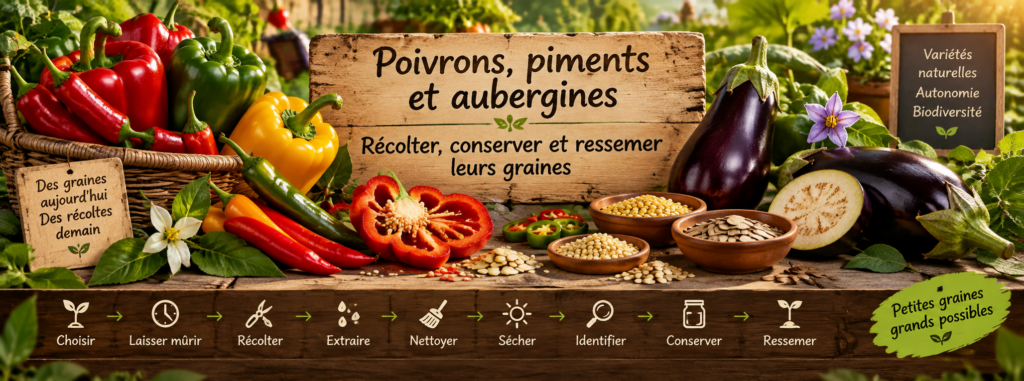
Harvest, store and resow their seeds
Peppers, chilli peppers and aubergines are valuable additions to a seed reserve, but they require particular care when it comes to fruit maturity and pollination.
To obtain viable seeds, the fruits must be allowed to reach well beyond the stage at which they are sometimes harvested for eating.
The aim is to follow a simple cycle:
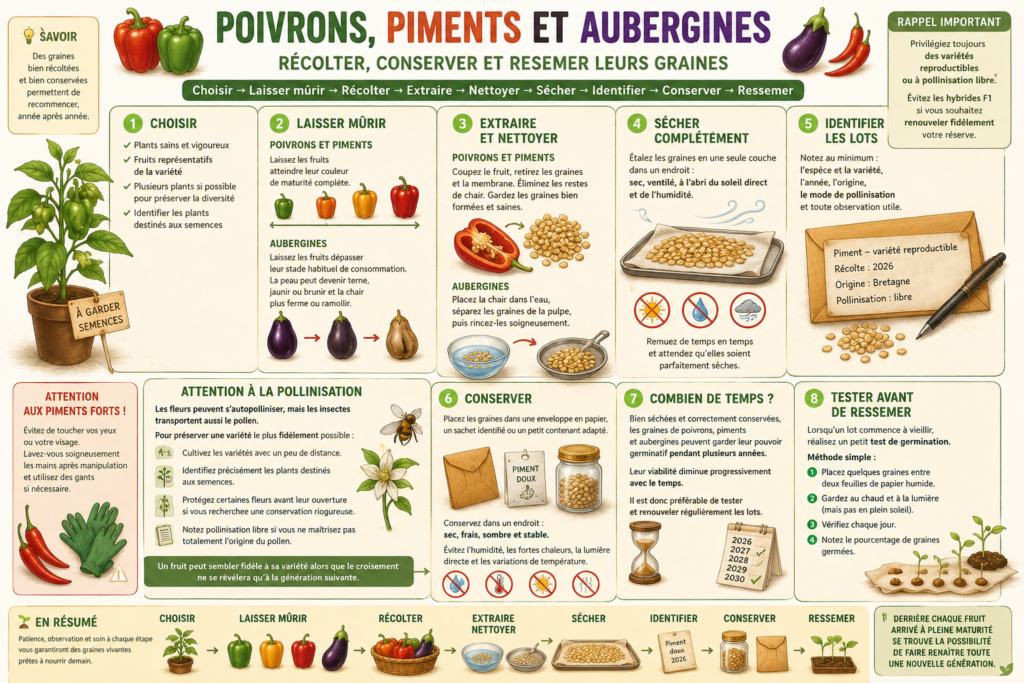
Select → Allow to ripen → Harvest → Extract → Clean → Dry → Label → Store → Resow
🌱 Choose the right varieties
To produce seeds intended for storage, give preference to:
- some reproducible varieties or open-pollinated varieties;
- healthy, vigorous plants;
- fruits that are representative of the variety;
- plants that are well adapted to your climate and growing conditions;
- several plants whenever possible, in order to preserve greater diversity.
⚠️ Avoid F1 hybrids for this purpose
F1 hybrids can produce excellent fruit.
But their seeds generally do not faithfully reproduce the characteristics of the previous generation.
For a reserve intended to be renewed year after year, it is therefore preferable to choose stable, reproducible varieties.
🐝 Watch out for pollination
The flowers of peppers, chilli peppers and aubergines can self-pollinate, but insects can also carry pollen between different flowers.
Cross-pollination between compatible varieties can therefore occur.
To preserve a variety as faithfully as possible, it may be useful to:
- grow the different varieties with some distance between them;
- clearly identify the plants intended for seed production;
- protect certain flowers before they open if very strict preservation is required;
- note open pollination when the origin of the pollen cannot be fully controlled.
A fruit may appear perfectly true to its variety, while the cross only becomes apparent in the next generation.
🌶️ Allow the fruits to reach full maturity
To produce viable seeds, choose fruits from healthy plants that are representative of the variety, then allow them to ripen further than you would for fruit intended simply for eating.
🫑 Peppers and chilli peppers
A pepper or chilli pepper intended for seed production should generally reach its full mature colour.
Depending on the variety, the fruit may change:
green → yellow → orange → red, or take on another characteristic colour.
Wait until the fruit is fully ripe, coloured and fully developed before collecting its seeds.
🍆 Aubergines
Aubergines are often eaten before their seeds are fully mature.
To produce seeds, the fruit should be left to go well beyond its usual eating stage.
Depending on the variety, it may:
- lose its glossy appearance;
- become duller;
- turn yellow or brown;
- become firmer or, on the contrary, begin to soften.
The seeds inside then become more developed and harder.
A fruit intended for eating is harvested when it is ready to eat. A fruit intended for seed production should remain on the plant until its seeds are fully mature.
🔪 Extract and clean the seeds
🫑 Peppers and chilli peppers
Cut the fully ripe fruit and collect the seeds attached inside.
Remove any pieces of flesh or membrane, then preferably keep the seeds that are:
- well formed;
- firm;
- of a normal colour for the variety;
- free from any signs of mould or deterioration.
Then spread them out on a clean surface to begin drying.
⚠️ Be careful with hot chilli peppers
When handling very hot chilli peppers, avoid touching your eyes or face.
Wash your hands thoroughly after handling them and, if necessary, use gloves.
🍆 Aubergines
Cut the fully ripe aubergine and collect the flesh containing the seeds.
Place it in a container with a little water, then gradually separate the seeds from the pulp.
Rinse them thoroughly to remove any remaining flesh.
Preferably keep the seeds well formed and full, then drain them before drying.
💨 Dry completely
Spread the seeds in a single layer in a place that is:
dry, well ventilated, and protected from direct sunlight and moisture.
Stir them from time to time and wait until they are completely dry before storing them.
A poorly dried seed can lose in just a few days what the plant took an entire season to produce.
🏷️ Label the batches
Once the seeds are completely dry, clearly label each batch.
Note at least:
- 🌶️ the species and variety ;
- 📅 the year of harvest ;
- 📍 the origin or growing location ;
- 🐝 the pollination method, s’il est connu ;
- 📝 any useful observations.
Example:
Chilli pepper — reproducible variety
Harvest: 2026
Origin: Brittany
Pollination: open
🫙 Where should they be stored?
Place the seeds in a paper envelope, a labelled bag, or a small suitable container.
Store them in a place that is:
dry, cool, dark and stable.
Avoid moisture, high temperatures, direct sunlight and significant temperature fluctuations.
⏳ How long?
When properly dried and stored, the seeds of peppers, chilli peppers and aubergines can retain their ability to germinate for several years.
Their viability gradually decreases over time.
It is therefore preferable to regularly test and renew the batches.
🌱 Test before resowing
When a batch begins to age, carry out a small germination test before relying on it for a new crop.
Preserving a seed is not simply about storing it: it must be kept capable of starting the cycle again.
✅ Peppers, chilli peppers and aubergines — Key points
- 🌱 Choose reproducible varieties and healthy plants.
- ⚠️ Avoid F1 hybrids when you want to renew the reserve faithfully.
- 🐝 Monitor pollination and identify the plants intended for seed production.
- 🌶️ Allow to ripen fully peppers and chilli peppers until they reach their full mature colour.
- 🍆 Allow the aubergines to go beyond their usual eating stage so that their seeds can fully mature.
- 🔪 Extract and clean the seeds carefully.
- 🧤 Handle hot chilli peppers with care.
- 💨 Dry completely before storing them.
- 🏷️ Label the species, variety, year, origin and, if possible, the pollination method.
- 🫙 Store in a dry, cool and dark place.
- 🌱 Test germination as the batches age.
Select → Allow to ripen → Harvest → Extract → Clean → Dry → Label → Store → Resow
Behind every fully ripe fruit lies the possibility of bringing an entirely new generation to life.
🇫🇷 Version française
🇬🇧 English version
To understand the full approach, visit the Seed Harvesting Project and discover the other practical guides dedicated to seed preservation and the passing on of knowledge.
Also discover the work of FAO on the conservation of plant genetic resources for food and agriculture.