
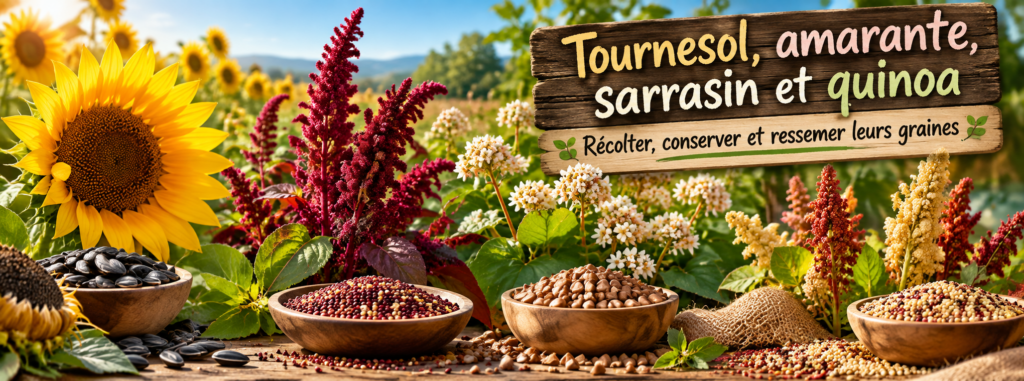
Harvest, store and resow their seeds
These plants can be very valuable additions to a seed reserve, both for their nutritional value, their diversity, and their ability to complement a food-producing garden.
However, they are not all harvested in the same way. Some mainly require waiting until full maturity, while others need greater care when it comes to pollination or harvesting small seeds.
The aim is to follow a simple cycle:
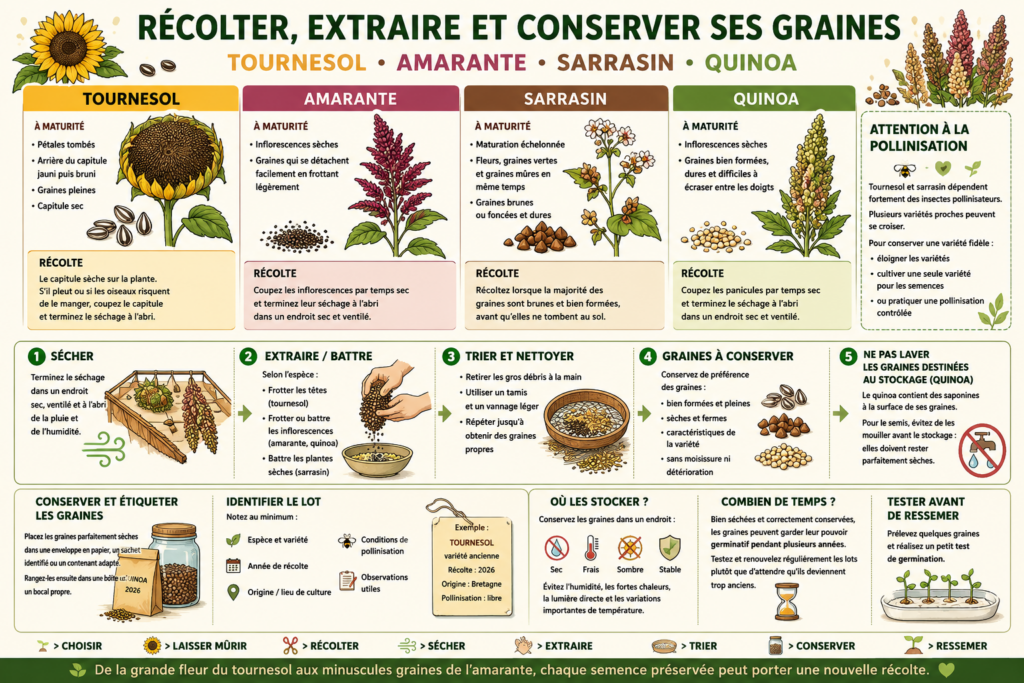
Choose → Allow to ripen → Harvest → Dry → Thresh or extract → Sort → Store → Resow
🌱 Choose the right varieties
To produce seeds intended for storage, give preference to:
- some reproducible varieties ;
- heritage or open-pollinated varieties;
- healthy, vigorous plants;
- plants that are well adapted to your climate;
- several plants whenever possible, in order to preserve greater diversity.
🌻 Sunflower
Sunflower is particularly valuable because its seeds can be used both as seeds and as food source.
To produce seeds intended for resowing, choose flower heads from plants that are:
- healthy;
- vigorous;
- well formed;
- representative of the variety;
- fully matured.
🐝 Watch out for pollination
Sunflowers strongly attract bees and other pollinators.
When several varieties flower close to one another, cross-pollination can therefore occur easily.
To preserve a variety as faithfully as possible, it may be useful to:
- keep the different varieties apart;
- grow only one variety intended for seed production;
- or use controlled pollination when more rigorous preservation is required.
With sunflowers, a beautiful flower head is not enough: you also need to know which pollen fertilised it.
🌻 Allow sunflowers to mature and harvest the seeds
To produce viable seeds, allow the flower head to reach full maturity on the plant.
Over time:
the petals fall → the back of the flower head turns yellow, then brown → the seeds fill out → the flower head gradually dries.
When the seeds are fully formed and the flower head begins to dry, it can be harvested.
If the weather becomes too damp or birds are likely to take the seeds, you can cut the flower head and finish drying it in a place that is:
dry, well ventilated and protected from the rain.
✋ Extract and sort the seeds
Once the flower head is completely dry, rub it gently to loosen the seeds.
Preferably keep seeds that are:
well formed;
full and firm;
characteristic of the variety;
free from any signs of mould;
free from significant insect or bird damage.
Discard any empty, badly damaged or suspicious-looking seeds.
A single flower head can contain hundreds of seeds: choosing them carefully can turn one flower into many possible future harvests.
🌿 Amaranth
Amaranth produces a very large number of small seeds grouped together in its flower clusters.
It can be a valuable addition to a seed reserve, but harvesting requires a little patience because the seeds are tiny and can easily fall once they reach maturity.
To produce seeds, preferably choose plants that are:
- healthy and vigorous;
- representative of the variety;
- well adapted to your growing conditions;
- from several plants whenever possible.
🌾 Know when to harvest
When the seeds reach maturity, the flower clusters begin to dry and the seeds come away easily when gently rubbed between your fingers.
However, do not wait too long, as some of the seeds may naturally fall to the ground.
The right time is when the seeds are mature, but before the plant begins to disperse them.
✂️ Harvest the flower clusters
Cut the flower clusters in dry weather.
Then place them in a paper bag, on a clean cloth or in a sufficiently large container.
If necessary, finish drying them in a place that is:
dry, well ventilated and protected from moisture.
🤲 Extract the seeds
Once the flower clusters are completely dry, rub them gently between your hands or over a container to release the seeds.
There will generally be a mixture of:
seeds → small flower fragments → pieces of stems → plant debris.
They will then need to be sorted and cleaned before storage.
A single amaranth plant can produce an enormous number of seeds: just a few well-preserved plants can provide for many generations.
🧺 Sort and clean amaranth seeds
After extraction, the seeds are often mixed with many small pieces of plant debris.
To clean them, you can:
- first remove the larger pieces by hand;
- use a sieve suited to the size of the seeds;
- gently pour the mixture from one container to another to remove some of the dust and lighter fragments;
- repeat the process until the seeds are as clean as possible.
💨 Be careful when winnowing
Amaranth seeds are very small and very light.
If you use wind or a gentle breeze to separate the debris, proceed very carefully so that the seeds are not blown away with the waste.
🌬️ Check the drying
Before storing them, make sure the seeds are completely dry.
If necessary, spread them out for a few more days on a clean surface, in a place that is:
dry, well ventilated and protected from moisture.
The smaller a seed is, the more precision its preservation requires: drying, cleaning and labelling become essential.
🌾 Buckwheat
Buckwheat produces larger seeds than amaranth, but harvesting requires care because not all the seeds ripen at exactly the same time.
To produce seeds intended for storage, preferably choose plants that are:
- healthy and vigorous;
- well adapted to your growing conditions;
- representative of the variety;
- grown from reproducible seeds.
🐝 Watch out for pollination
Buckwheat relies heavily on pollinators pollinating insects.
Bees and other pollinators play an important role in seed formation.
When several compatible varieties flower close to one another, cross-pollination may therefore occur.
To preserve a variety as faithfully as possible, it is preferable to:
- avoid growing different varieties too close together;
- clearly identify the plot intended for seed production;
- save seeds from several plants.
🌾 Know when to harvest
Buckwheat ripening is often staggered.
On the same plant, you may find at the same time:
flowers → green seeds → fully ripe, dark seeds.
You do not necessarily need to wait until all the seeds are fully ripe, as the earliest ones may fall to the ground.
Harvest when most of the seeds have turned brown or dark and are well formed.
With buckwheat, harvesting at the right time means finding the balance between maturity and losing the earliest seeds.
✂️ Harvest and finish drying
When most of the seeds are ripe, cut the stems or seed-bearing parts, preferably in dry weather.
Place them on a clean cloth, in a large paper bag, or in an area where any seeds that fall during drying can be collected.
Then leave them to dry in a place that is:
dry, well ventilated, and protected from rain and moisture.
The additional drying period allows the fully formed seeds to lose enough moisture before cleaning and storage.
🤲 Thresh to collect the seeds
Once the plants are completely dry, shake or gently thresh them over a cloth or container.
The ripe seeds will gradually come loose.
You will generally end up with a mixture of:
seeds → stem fragments → dried leaves → plant husks.
🧺 Sort and clean
First remove the larger debris by hand.
You can then use a sieve or a light winnowing to gradually separate the seeds from the lighter plant material.
Preferably keep seeds that are:
- well formed and full;
- dry and firm;
- characteristic of the variety;
- free from mould or visible damage.
Harvesting buckwheat is not about finding the perfect moment: it is about preserving as many ripe seeds as possible before they naturally return to the soil.
🌾 Quinoa
Quinoa produces many small seeds grouped together in large flower clusters.
To produce seeds intended for storage, preferably choose plants that are:
- healthy and vigorous;
- representative of the variety;
- well adapted to your climate;
- issues de reproducible varieties ;
- from several plants whenever possible.
🌱 Know when to harvest
At maturity, the plant generally begins to lose its leaves and the flower clusters become drier.
The seeds should be:
well formed → firm → difficult to crush between your fingers.
Harvesting too early results in immature seeds, while waiting too long increases the risk of losses caused by wind, birds or moisture.
Quinoa intended for seed production should be harvested when the seeds have fully developed, not simply when the plant appears dry.
✂️ Harvest the flower clusters
Cut the panicles in dry weather.
Then place them on a clean cloth or in an area where any seeds that fall can be collected.
If necessary, finish drying them in a place that is:
dry, well ventilated and protected from moisture.
🤲 Thresh and collect the seeds
Once the flower clusters are completely dry, rub or gently thresh them to release the seeds.
You will obtain a mixture of small seeds and plant debris.
Then use a sieve and gentle winnowing to gradually clean the batch.
⚠️ Do not wash seeds intended for storage
Quinoa naturally contains saponins on the surface of its seeds.
For food consumption, they are generally removed by washing.
But for seeds intended to be stored and resown, avoid getting them wet before storage: they must remain completely dry.
Quinoa is washed before eating. It should be kept dry when preserving it for seed.
🫙 Store and label the seeds
Once the seeds are completely dry and properly cleaned, place them in a paper envelope, a labelled bag, or a small suitable container.
You can then group the different batches together in a clean box or jar to better protect them from moisture and pests.
🏷️ Always label the batch
Note at least:
- 🌱 the species and variety
- 📅 the year of harvest
- 📍 the origin or growing location
- 🐝 the pollination conditions, when relevant
- 📝 any useful observations about the plant or harvest
Example:
Sunflower — heritage variety
Harvest: 2026
Origin: Brittany
Pollination: open
🌡️ Where should they be stored?
Store the seeds in a place that is:
dry, cool, dark and stable.
Avoid moisture, high temperatures, direct sunlight and significant temperature fluctuations.
⏳ How long?
When properly dried and stored, sunflower, amaranth, buckwheat and quinoa seeds can retain their ability to germinate for several years, depending on the species and storage conditions.
It is still preferable to regularly test and renew the batches rather than waiting until they become too old.
🌱 Test before resowing
When a batch begins to age, take a few seeds and carry out a small germination test.
A stored seed is only truly a reserve if it can still come back to life.
✅ Sunflower, amaranth, buckwheat and quinoa — Key points
- 🌱 Choose reproducible varieties and healthy plants.
- 🐝 Monitor pollination, particularly for sunflower and buckwheat.
- 🌻 Allow to ripen allow the seeds to mature sufficiently before harvesting.
- ✂️ Harvest at the right time to minimise losses.
- 🤲 Extract or thresh the seeds according to the species.
- 🧺 Sort and clean carefully sort and clean the batches.
- 💨 Winnow carefully very small seeds such as amaranth seeds.
- ⚠️ Keep quinoa dry when it is intended for sowing.
- 🏷️ Label the species, variety, year, origin and, where necessary, the pollination conditions.
- 🫙 Store in a dry, cool and dark place.
- 🌱 Test germination as the batches age.
Choose → Allow to ripen → Harvest → Dry → Extract → Sort → Store → Resow
From the large sunflower bloom to the tiny seeds of amaranth, every preserved seed can carry the promise of a new harvest.
🇫🇷 Version française
🇬🇧 English version
To understand the full approach, visit the Seed Harvesting Project and discover the other practical guides dedicated to seed preservation and the passing on of knowledge.
Also discover the work of FAO on the conservation of plant genetic resources for food and agriculture.