🌱 Learning to Build Peace
Peace does not begin only when conflicts end. It is also built through what we learn, what we pass on and the way we learn to see others.
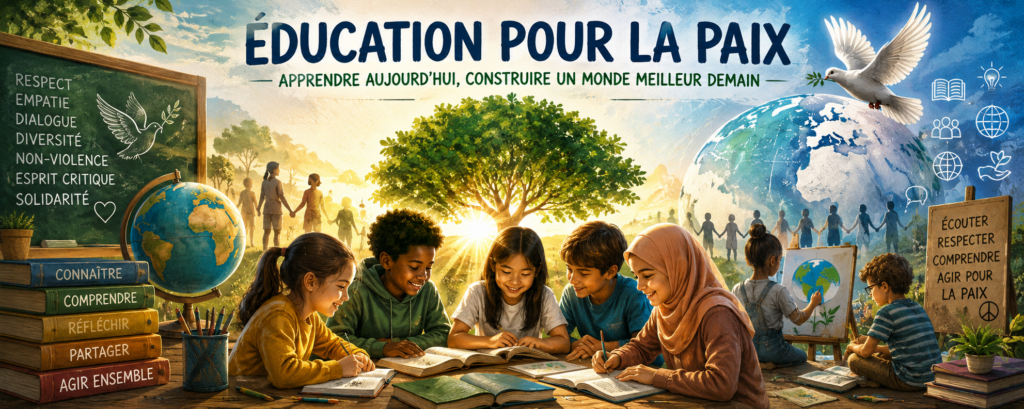
Education for Peace aims to progressively offer content and initiatives that explore tolerance, respect, empathy, dialogue, cultural diversity, non-violence, critical thinking and the protection of all living things.
The aim is not to impose a particular worldview, but to provide tools to understand, question, exchange ideas and learn to live together despite our differences.
These resources may take different forms and be intended for both children and young people as well as parents, educators, teachers and associations.
Because learning about peace today may help us avoid having to rebuild tomorrow what violence has destroyed.
🧠 Learning How to Think, Not What to Think
Peace education is not about passing on a ready-made truth. It should also enable everyone to develop their critical thinking, ask questions, compare information and form their own perspective.
Learning to recognise a source, distinguish a fact from an opinion., understanding that the same event can be told from different perspectives and knowing how to question information are also part of this approach.
Dialogue then becomes a learning tool: listening without necessarily agreeing, expressing arguments without contempt, and accepting that our certainties may sometimes evolve.
Because a society capable of thinking, engaging in dialogue and verifying what it believes it knows is also better equipped to resist manipulation, hatred and division.
🤝 Learning to Live Together
Peace is also learned through the way we live with others. Respecting differences, resolving disagreements without violence, listening before judging, and learning to cooperate are all things that can be taught from an early age.
Through content adapted to different age groups, Education for Peace pourra proposer stories, activities, games, educational materials, testimonies or resources that make it possible to explore these subjects in a simple way.
The aim will also be to introduce people to other cultures, other histories and other ways of seeing the world.so that difference is no longer necessarily perceived as a threat, but also as an opportunity to learn.
Learning to live together does not mean becoming all the same. It means learning to respect what makes us different without forgetting what brings us together.
🌍 Preparing Tomorrow’s Generations
Children and young people inherit a world they did not choose, with its richness, but also its conflicts, injustices and environmental challenges.
Our responsibility is not to pass on our fears or divisions to them, but to give them the tools they need to understand the world and, tomorrow, freely take part in shaping it.
Education for Peace therefore aims to encourage curiosity, cooperation, respect for all living things, the ability to engage in dialogue and confidence in each person’s ability to make a difference.
It is not about asking future generations to solve on their own what previous generations have failed to resolve, but to give them more tools so that they can create their own paths.
Educating for peace is not about writing their future for them. It is about giving them the means to write their own.
📚 Contribute to Education for Peace
Are you a teacher, educator, youth leader, organisation, researcher, parent, artist or simply someone with an idea for teaching peace in a different way?
You can submit an activity, an educational resource, a story, a game, a video, a workshop, a resource or an initiative. that can help develop dialogue, respect, critical thinking and the ability to live together.
Proposals intended for children and young people should be age-appropriate, respectful of their development and supported by sources when they present factual information.
Because peace education can also be built collectively, all skills, cultures and experiences can contribute to building it.
You can also discover the other World Peace Anthem projects and choose the one you would like to contribute to.
“Passing on peace is not about giving future generations all the answers. It is about teaching them to seek, understand, engage in dialogue and build their own.”